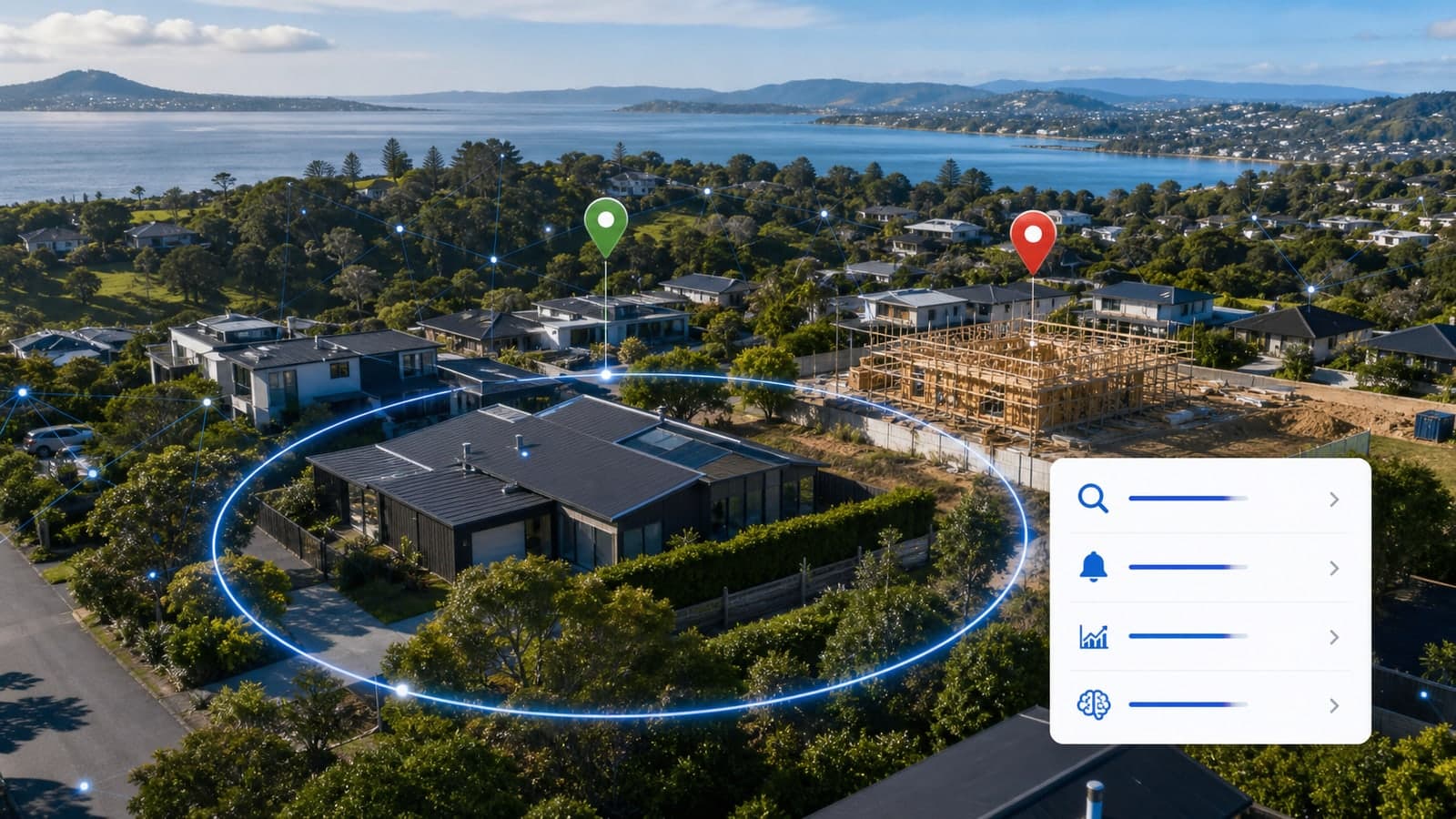
Consenty is a New Zealand building and resource consent data aggregator. It lets users search the available council records held by the platform without visiting separate council websites or contacting each council for an initial search.
One search layer across multiple council datasets.
Consenty standardises source records into one map and search experience. Start free in one district, upgrade to Consenty+ for complete nationwide search and Ask Consenty, or use Consenty Max to connect compatible AI tools through a controlled, read-only MCP service.
Start with a free accountWhat a consent data aggregator does.
New Zealand councils publish consent information in different formats, with different field names and update schedules. One council may publish PDFs, another CSV files, and another may separate applications received from decisions issued. Searching each source individually takes time and makes cross-council comparison difficult.
Consenty collects available public records, normalises important fields and retains the source council. Depending on the source, a record can include an address, status, consent or service-request number, dates, consent type, applicant or agent, legal parcel and a description of the proposed work.
Move between available council areas without learning a different search system for each source.
Council-specific labels are presented through clearer Received, On hold and Approved stages where the source supports them.
Save an address and receive an email when newly published consent activity falls within the selected radius.
Important records keep the council and reference needed for verification or a complete-file request.
Search without contacting council does not mean replacing the official record.
Consenty can remove the need to contact several councils merely to discover whether a relevant record exists. The complete plans, conditions, correspondence and authoritative history remain council-held. Older records and councils outside current coverage may also require direct council research.
Finding a consent should not require opening another service-desk ticket.
Contacting council remains the right step when an official file, authoritative answer or professional clarification is needed. But many people never reach that point because the first enquiry feels uncertain: they do not know which team to email, what record to request or which reference number council needs.
Others are reluctant to create another council interaction. They may worry that their name, email address or correspondence could become part of a council record or later be disclosed, feel frustrated about paying substantial rates while still having to navigate an unfamiliar service desk, or have had poor experiences reporting matters such as noise, roads or local maintenance. A consent enquiry is easily placed in the “too hard” basket.
Building, planning, property-file and information-request teams may use different inboxes and processes.
Without the correct address, council, record type and reference, it can be difficult to frame a useful request.
Some people prefer not to attach their identity and contact details to an exploratory council enquiry.
Previous service-desk delays or poor experiences can discourage people from opening a request unless the issue truly matters.
Most consent activity does not justify that effort.
A replacement fireplace, renovated bathroom or other routine work may be useful context without affecting a neighbour’s daily life. Homeowners and renters are more likely to investigate subdivisions, major earthworks, multi-unit developments, demolition or substantial new buildings that could change construction noise, traffic, privacy, sunlight, outlook or the character of the street.
| Useful to know | More likely to justify further research |
|---|---|
| Fireplace installation, bathroom alterations, minor plumbing or routine internal work. | Subdivision, new dwellings, multi-unit development or a major change of use. |
| Small maintenance projects that are unlikely to change how nearby properties are experienced. | Earthworks, demolition, retaining work, access changes or construction likely to affect noise and traffic. |
The arrival of diggers should not be the first notification.
Many property owners first realise something significant has been approved next door when machinery arrives, fences go up and earthworks begin. By then, the consent process may be complete and the practical effects—construction noise, vibration, dust, traffic, privacy changes or a different outlook—are no longer hypothetical.
Neighbours may have had no formal input into an application and may not have been individually notified. That does not necessarily mean the council process was incorrect, but it can leave people completely unaware of what has been approved over the fence. For an owner or renter whose home and daily life may be affected, discovering the project only when work starts feels too late.
Earlier visibility gives people time to understand the proposal, obtain the relevant council-held documents, ask informed questions and prepare for likely disruption—even where they do not have a formal right to influence the decision.
Consenty makes the first screening step easier. Search the available summary, decide whether the work matters to you, and only request the complete council-held file when the detail is worth pursuing.
Free local research or complete Consenty+ search.
22 Hill Street, Thorndon
Two-unit residential development and associated earthworks.
The free plan monitors one address within 250 metres and emails you when a matching consent is received or approved. Your account also includes local map search, two saved favourites and full details for alerts linked to your monitored address.
| Plan | Search and monitoring | Best for |
|---|---|---|
| Free | One selected district, one monitored address within 250 metres, local consent search with masked references, two favourites, and daily free-map lookup limits. | Basic research around a home or one local area. |
| Consenty+ | Nationwide Consenty search, complete record details, Ask Consenty, two monitored addresses up to one kilometre, ten favourites and 30 combined map lookups daily. | Homeowners, buyers, landlords and regular property research. |
| Consenty Max | Everything in Consenty+, ten monitored addresses, 50 combined map lookups daily and bounded MCP access with 900 shared monthly credits. | Professional research and compatible AI or internal workflows. |
Consenty+ costs $25 NZD monthly or $20 per month when $240 is billed yearly. It includes one council document request each month with no rollover; additional resource-consent requests cost $19. A free user can order a resource-consent file for $25, while building-consent file prices may vary by council.
Ask Consenty turns a question into a map search.
Ask Consenty is included with Consenty+. Instead of guessing the exact words used by every council, describe the type of work you want to find. Consenty extracts useful terms, searches the consent data and returns matching properties on the map.
I searched consent descriptions, types and approved dates. The matching properties are highlighted on the map.
- “Show properties with swimming pools.”Search descriptions for pool-related work and return matching consent records.
- “Find subdivisions near this address.”Look for subdivision and lot-related descriptions in the relevant map area.
- “Show new dwellings approved recently.”Combine work-type terms with status and date context.
- “Find consents involving this agent.”Search available applicant or agent information where the source council supplies it.
Ask Consenty is a focused search assistant, not a general-purpose planning opinion. It searches the records Consenty holds and remains subject to coverage, data quality and plan limits.
Ask the question in ordinary language.
Search complete consent details across every council dataset currently held by Consenty and place matching properties directly on the map.
Create a Consenty+ accountUse consent data through a read-only MCP connection.
Model Context Protocol, or MCP, provides a standard way for a compatible AI client to call an external tool. Consenty Max exposes a read-only consent-search tool through OAuth, allowing approved clients such as Claude, ChatGPT, Codex and other compatible systems to request focused consent information.
The benefit is not merely another chat box. MCP allows consent search to sit inside an existing research workflow: an AI assistant can ask for a council, date range, consent type, status, address, suburb or relevant work description, then receive structured records from Consenty.
Consenty MaxRead-only MCP response
{
  "query": {
    "council": "South Wairarapa District Council",
    "status": "approved",
    "from": "2026-08-01",
    "to": "2026-08-31",
    "keywords": ["subdivision"],
    "limit": 50
  },
  "meta": {
    "records_returned": 12,
    "credits_used": 12,
    "read_only": true
  },
  "results": [
    {
      "reference": "RC260184",
      "status": "Approved",
      "consent_type": "Subdivision",
      "decision_date": "2026-08-14"
    }
  ]
}Work from a compatible AI client while Consenty remains the controlled data source.
Authorise the connection without sharing database credentials with the AI client.
Return council, address, reference, dates, status and available property details in a consistent format.
Use focused queries for due diligence, pipeline research, monitoring and internal property analysis.
All available council datasets, with enforced boundaries.
Max includes 900 shared data credits each month and ten monitored addresses. It costs $200 NZD monthly or $150 per month when $1,800 is billed yearly. Existing Consenty+ customers receive Stripe's prorated credit when upgrading.
Why MCP access is bounded rather than a bulk export.
Consent data has commercial value, and unlimited extraction would make it easy to copy the entire database through a series of broad prompts. Consenty therefore enforces access limits on the server rather than relying on an AI client to follow a polite instruction.
- 31-day query windowsEach MCP request is limited to a focused date range.
- 50-result responsesBroad searches must be narrowed before excessive data is returned.
- Credit checks firstConsenty checks the account balance before releasing chargeable records.
- Anti-harvesting controlsSequential enumeration, unusual cumulative coverage and attempts to bypass limits can pause access for review.
The MCP service is designed to answer legitimate, specific property questions—not “give me every consent in New Zealand.” Coverage is not exhaustive, and every material conclusion should be checked against the relevant council record.
Building consent data aggregator FAQs
What is a New Zealand building consent data aggregator?
A building consent data aggregator collects available consent records published by multiple councils, standardises important fields and makes them searchable through one interface. Consenty combines available building and resource consent records while retaining the source council and record reference.
Can I search New Zealand building consents without contacting each council?
Yes, for the council records currently held by Consenty. You can search the aggregated database without visiting each council website or making an initial information request. You may still need to contact the relevant council—or ask Consenty to act as your agent—to obtain the complete official file or older records.
Does Consenty contain every New Zealand building consent?
No. Coverage depends on the datasets councils publish, their formats, update schedules and Consenty's current council coverage. Consenty began collecting data on 1 January 2026. The coverage page identifies the areas and consent types currently available.
What is Ask Consenty?
Ask Consenty is the natural-language search included with Consenty+. A user can describe the work they want to find—such as swimming pools, subdivisions or new dwellings—and Consenty extracts useful search terms, searches matching consent descriptions and places the results on the map.
Can Claude, ChatGPT or another AI tool search Consenty data?
Consenty Max provides OAuth-authenticated, read-only MCP access for compatible clients such as Claude, ChatGPT, Codex and other tools that support the required MCP connection. Client capabilities change, so compatibility should be confirmed with the relevant AI provider.
What does Consenty+ include?
Consenty+ includes nationwide search across the Consenty database, complete record details, Ask Consenty, two monitored addresses with radiuses up to one kilometre, ten favourite consents and one council document request each month with no rollover. Additional document requests are available at the member rate.
Can MCP users export the complete Consenty database?
No. MCP access is designed for focused research, not bulk harvesting. Server-enforced limits include bounded date ranges, result caps, data credits, daily search controls, logging and anti-enumeration safeguards.
Is Consenty an official council database?
No. Consenty is an independent consent-data and property-intelligence service. It retains source council information, but users must verify material details with the relevant council and obtain professional advice where appropriate.
How do I obtain the full building consent file?
The complete file remains council-held. Free users can request Consenty to act as their agent for $25. Consenty+ and Max include one request each month with no rollover, with additional resource-consent requests available for $19; building-consent file prices may vary by council.
See Consenty's coverage page for currently available councils, pricing page for current plan limits and charges, and public MCP guide for connection and usage-control details.
Consenty is an independent service, not a council or government agency. It presents information sourced from public council records and does not provide legal, planning, building, valuation or property advice. Coverage is not exhaustive. Verify material information with the relevant council and qualified advisers.