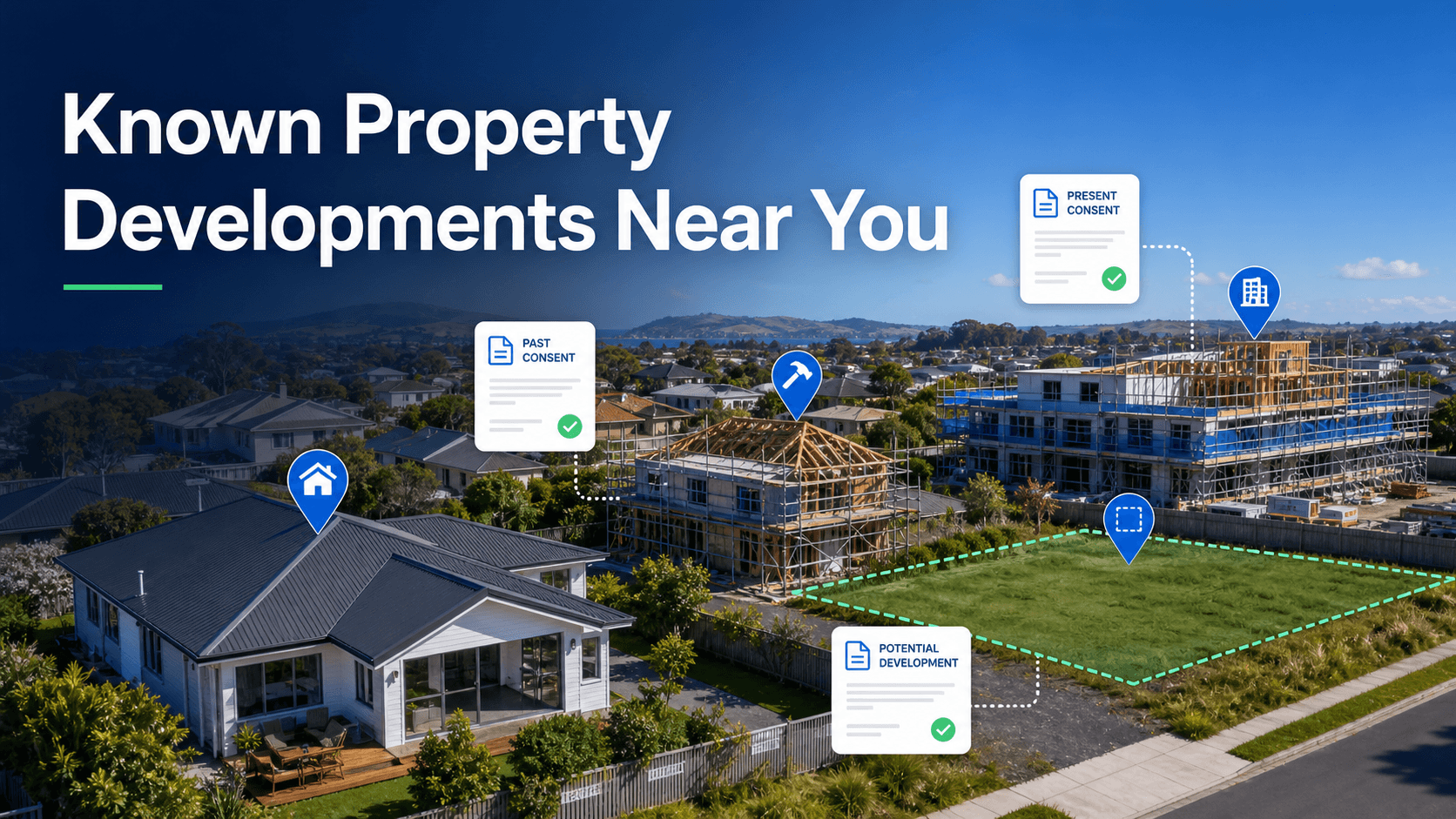
To check known property developments in your area, search both building consent and resource consent records around the address—not only the LIM or property file for the home itself.
Search the neighbourhood, then monitor the address.
A map-based consent search can reveal recorded work and applications on surrounding sites. Check council planning information and full consent files for important details, then use alerts to catch newly available records while you are deciding whether to buy or rent.
Search an address freeThe house is only part of the decision.
A property may look quiet during an open home while significant work is approved or proposed nearby. Development can bring new homes and amenities, but it can also change outlook, sunlight, privacy, traffic, parking and construction noise.
A consent on the adjoining site may affect how you value the property or what conditions you include in an offer.
Living beside demolition, earthworks or a multi-stage build can be very different from the viewing-day experience.
Several consents can reveal gradual intensification or redevelopment that is difficult to see from one inspection.
Nearby applications can provide context for subdivision, additions or redevelopment you may later consider.
Do not assume someone else searched every neighbouring site.
A lawyer or conveyancer may review the sale agreement, title, LIM and legal matters affecting the property being purchased. A systematic search for consents on surrounding properties may not form part of that standard scope. Ask your adviser exactly what will be checked and carry out separate neighbourhood research where it matters to you.
Building and resource consents reveal different clues.
| Record | What it may reveal | What it does not prove |
|---|---|---|
| Building consent | New buildings, additions, structural changes, plumbing, drainage and other consented building work. | That work has started, finished, received a code compliance certificate or will look exactly as first proposed. |
| Resource consent | Land-use proposals, subdivision, earthworks and development requiring planning or environmental approval. | That building consent has been granted, construction is imminent or every effect will occur. |
| LIM | Council-held information about the property named in the LIM request. | A complete search of all proposed activity on neighbouring properties. |
| Property or consent file | Plans, reports, correspondence, decisions and conditions available from the relevant council. | Unlodged private plans or a guarantee that an approved project will proceed. |
Checking both consent types provides a wider picture. A project can require building consent, resource consent, both, or neither, depending on its design and the rules applying to the site.
Look at past, present and known future activity.
- Past developmentEarlier consents may explain additions, subdivisions, drainage work or the built form already visible.
- Present activityRecently issued or active records may relate to work underway or approaching construction.
- Known proposalsLodged resource or building consent records can signal intended development before work is visible on site.
- What remains unknownPrivate ideas, pre-application discussions and applications not yet published cannot reliably be discovered.
A consent is evidence of an application or approval at a point in time—not a promise that the work will happen. Proposals can change, approvals can lapse and construction timing may remain uncertain.
Check the wider area before you commit.
Explore available consent activity on the map and monitor an address for newly matched building and resource consent records.
Start your free searchHow to investigate developments around an address.
- 01Search the address on Consenty
Use the nationwide map to review available building and resource consent records around the property—not just records attached to the property itself.
- 02Look across several years and streets
Consider adjoining sites, rear sections and nearby roads that could affect access, traffic, outlook or construction conditions.
- 03Check the relevant council
Review planning maps, public notices, the LIM and property files. Council systems differ, so use the source council reference to verify important records.
- 04Read the complete file
Obtain plans, conditions and the planner's report where available when a summary record could materially affect your decision.
- 05Monitor while you decide
Create an alert so newly available consent activity near the address is easier to catch during due diligence or before a tenancy begins.
Questions for buyers and renters to ask.
Could a nearby proposal affect value, outlook or planned use? Is a full file needed before the finance or due-diligence condition expires?
Are there consented works next door? Has the landlord or agent disclosed known construction, access constraints or likely disruption?
What stage is the record at, when was it lodged or issued, and does the description match the scale of work you are concerned about?
Which searches are included in your lawyer, planner or building inspector's scope, and what must you request separately?
Consenty began collecting consent data on 1 January 2026. Earlier records must be obtained directly from the council, and source availability means no database should be treated as exhaustive.
Checking nearby development FAQs
How do I find out about property developments near me?
Search available building and resource consent records by map and address, then check the relevant council's planning maps, public notices and property files where needed. Consenty brings currently available council consent records into one nationwide map and can alert you to matching activity near a monitored address.
Will a LIM show developments planned next door?
Do not assume it will. A LIM is prepared for the property named in the request and summarises information the council holds about that property. It may contain useful area information, but it is not a complete search of every neighbouring property. Nearby consent records should be checked separately.
What is the difference between a building consent and a resource consent search?
Building consent records relate to proposed building work and Building Code compliance. Resource consent records relate to activities that need approval under planning or environmental rules, including some land uses, subdivisions, earthworks and development that does not comply with permitted standards. Checking both gives a broader view.
Can I see future property developments?
You can see proposals once they enter an available public process or council dataset, but no search can reveal every private idea or future application before it is lodged. A consent may also change, lapse or never be implemented. Treat consent data as evidence of known activity, not a guaranteed construction forecast.
Are nearby resource consents always publicly notified?
No. Many resource consent applications are processed without public notification. Public notification and public availability of consent data are different concepts, so relying only on newspaper or council public notices can miss non-notified applications.
Should my property lawyer check neighbouring consents?
Ask explicitly. A lawyer or conveyancer's normal scope may focus on the title, agreement, LIM and legal issues affecting the property being purchased. A systematic search of consent applications on surrounding properties may not be included unless you request it. Confirm the scope of your due diligence with your adviser.
Why should renters check nearby developments?
A nearby project can affect noise, traffic, parking, privacy, outlook and access for months or years. Checking known consent activity before signing a tenancy can help a renter ask better questions, although a consent does not prove when—or whether—construction will begin.
How far back does Consenty's consent data go?
Consenty began collecting consent data on 1 January 2026. Records before that date must be obtained from the relevant council. Council publication practices, source availability and import schedules also affect what appears in Consenty.
Can I obtain the full consent and planner's report through Consenty?
The full council file, including plans, conditions and a planner's report where one exists, must be obtained from the relevant council. Some councils provide files free and others charge. Where offered, Consenty can act as your agent to request this information for a small fee.
Read Settled.govt.nz guidance on property-purchase documents, Building Performance guidance on consent requirements, and your relevant council's LIM, property-file, planning-map and consent pages.
Consenty presents information sourced from public council records. It is not a council or government agency, and its information is not legal, planning, building, tenancy, valuation or property advice. Always verify material records with the relevant council and qualified advisers before making a decision.