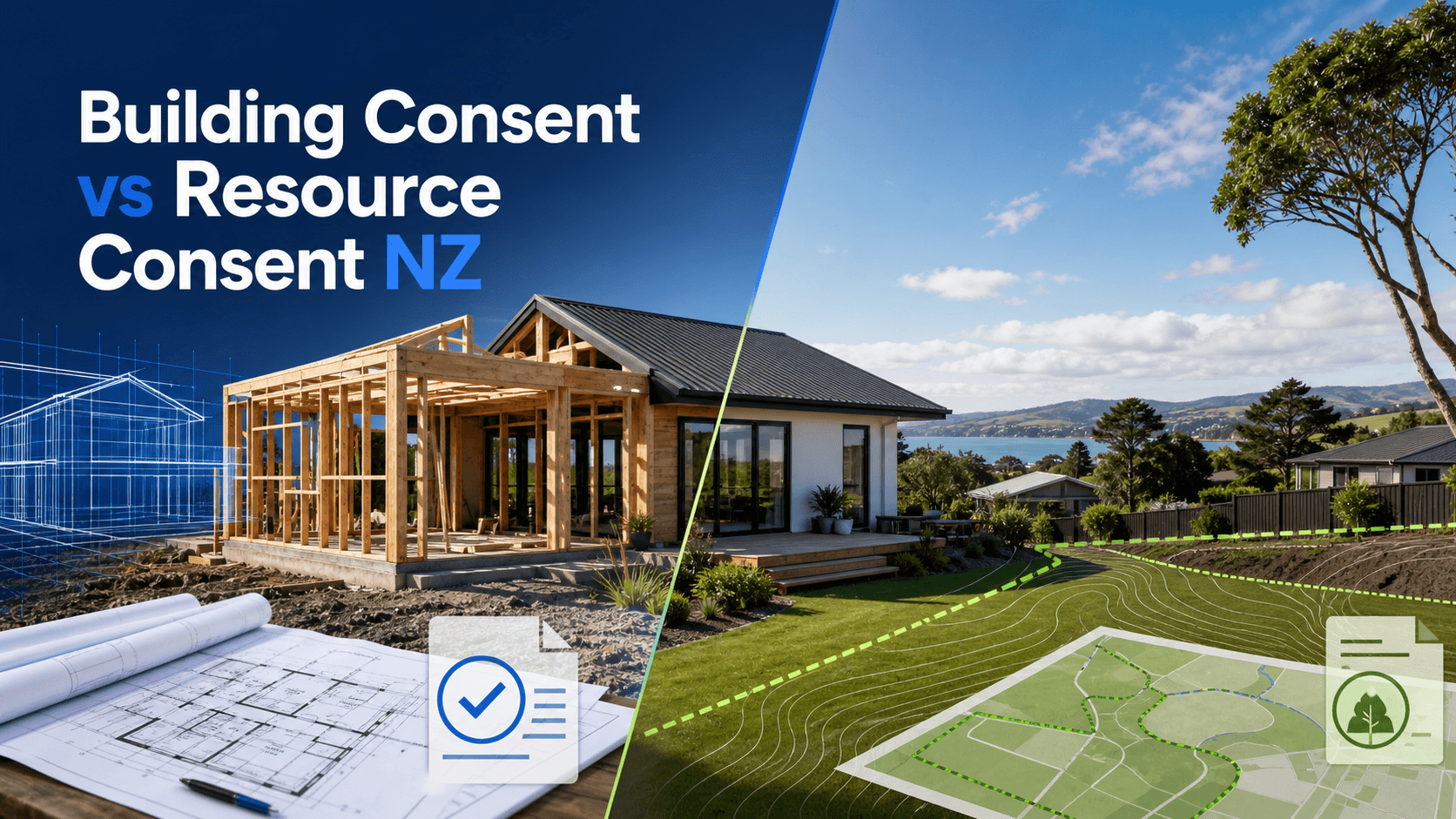
A building consent is primarily about whether building work will comply with the Building Code. A resource consent is primarily about whether an activity’s land-use or environmental effects are allowed under council planning rules.
One project can need two different approvals.
Building consent focuses on how the structure is designed and built. Resource consent focuses on where and how the activity occurs and its effects on land, neighbours and the environment. Obtaining one does not remove the need for the other.
Monitor a property freeBuilding consent vs resource consent.
| Question | Building consent | Resource consent |
|---|---|---|
| Primary focus | Safety, health, durability and Building Code compliance. | Land use, subdivision and effects on people or the environment. |
| Rules assessed | Building Act, Building Regulations and Building Code requirements. | Relevant district or regional plan rules and resource management requirements. |
| Common examples | New buildings, structural alterations, plumbing, drainage and specified systems. | Activities involving planning limits, subdivision, earthworks, discharges, water or coastal matters. |
| Decision maker | A building consent authority—commonly the local council. | The relevant city, district or regional council. |
| Completion evidence | A code compliance certificate may be issued for completed consented work. | Compliance is demonstrated by meeting consent conditions; there is no universal resource-consent equivalent of a CCC. |
Does the proposed building work meet the Building Code?
A building consent is formal approval for proposed building work. The building consent authority reviews plans and specifications to decide whether the work, if built as documented, is likely to comply with the New Zealand Building Code.
- Structural safetyFoundations, framing, bracing and other structural elements.
- Weather and moistureWeathertightness, drainage and protection from moisture.
- Fire and accessFire safety, escape routes and accessibility where applicable.
- Services and systemsPlumbing, drainage and specified building systems.
Some work is exempt from needing building consent. However, all building work must still comply with the Building Code, even when an exemption applies.
Is the activity allowed under the relevant planning rules?
A resource consent is council approval to carry out an activity that is not permitted as of right under the relevant district or regional plan. It considers the proposed activity, its location and its actual or potential effects.
- Land-use effectsHeight, setbacks, site coverage, privacy, shading, traffic and other planning matters.
- SubdivisionCreating new lots, changing boundaries or establishing associated access and services.
- Earthworks and hazardsCutting, filling, erosion, contaminated land or work in hazard-prone areas.
- Natural resourcesActivities involving water, discharges, waterways, vegetation or the coastal environment.
Official guidance describes resource consent as formal council approval for something not clearly identified as permitted in the relevant plan.
When might you need both consents?
Many projects cross the boundary between building work and land-use effects. Checking only one consent pathway can create delays, redesign costs or conditions that were not allowed for.
Building consent is likely for construction. Resource consent may also be needed if planning standards such as height, setbacks or site coverage are not met.
Structural work may require building consent, while shading, boundary or heritage rules could trigger resource consent.
Building Code approval and planning matters such as density, access, parking and neighbourhood effects may both apply.
Subdivision is a resource consent matter; later construction on the new lots can require separate building consents.
An approved land use does not approve the building work.
A resource consent might allow two new homes, associated earthworks and vehicle access on a section. Detailed plans for the homes may still need separate building consents before construction begins. Conversely, plans that satisfy the Building Code may still need resource consent if the project breaches a planning rule.
See both consent types in one place.
Monitor available building and resource consent activity near an address and receive matching email alerts.
Start monitoring freeSearch, map and monitor consent activity.
Consenty standardises available building and resource consent records so you can understand nearby activity without working through different council formats.
- 01Search the map
Explore building and resource consent records across all council datasets currently available in Consenty.
- 02Monitor an address
Add a property and choose an available radius for nearby consent alerts.
- 03Understand the record
Review the consent category, description, status, council reference and relevant dates where available.
- 04Request the full file
When you need plans, conditions or a planner’s report, Consenty can request the council-held file as your agent.
Consenty began collecting consent data on 1 January 2026. Records before that date, and any complete files not held in Consenty, must be obtained from the relevant council.
Building and resource consent FAQs
What is the main difference between building consent and resource consent?
Building consent checks whether proposed building work will comply with the New Zealand Building Code. Resource consent authorises an activity or use of land or natural resources that is not permitted as of right under the relevant district or regional plan. They assess different rules and effects.
Can a project need both building consent and resource consent?
Yes. A new home, major addition, multi-unit development or other project may need building consent for the physical construction and resource consent for matters such as land use, height, setbacks, earthworks, subdivision or environmental effects. Approval of one does not replace the other.
Which consent should I apply for first?
That depends on the project and council requirements. It is sensible to check planning and resource consent requirements early, before finalising detailed building plans. Your council, planner, architect or other qualified adviser can help establish an appropriate sequence.
Does resource consent mean I can start building?
Not necessarily. Resource consent does not replace a required building consent, and both approvals may include conditions that must be met before or during work. Do not begin consented building work until the required approvals are in place.
What is a code compliance certificate?
A code compliance certificate, commonly called a CCC, is issued by the building consent authority when it is satisfied on reasonable grounds that the completed building work complies with the building consent. It relates to building consent, not resource consent.
Does exempt building work still have to meet the Building Code?
Yes. New Zealand government guidance states that all building work must comply with the Building Code, even when a building consent is not required. Other permissions, including resource consent, may still be needed.
Are building and resource consent applications always publicly notified?
No. Notification rules differ. Most resource consent applications are processed on a non-notified basis, while councils publish building and resource consent information in different ways and on different schedules. Formal council notices and Consenty alerts are separate services.
How can Consenty help me monitor building and resource consents?
Consenty brings available council records collected from 1 January 2026 into one map, search and alert experience. You can monitor an address for nearby consent activity, search current available datasets and request complete council files through Consenty where offered.
Check Building Performance guidance on checking which consents you need and the Ministry for the Environment resource consent guide. Council plans and requirements vary, so confirm your project with the relevant council or a qualified adviser.
Consenty presents information sourced from public council records. It is not a council or government agency, and its information is not planning, legal, building or property advice. Always confirm consent requirements and material details with the relevant council and qualified professionals.